
Marketing Fundamentals for Founders - Workshop Recap
A Businettes Academy recap on Marketing Fundamentals for Founders with Lottie Unwin, founder of Up World, Brand Hackers, Up Talent
Most founders are trying to solve problems they don't have yet.
That's the pattern Lottie Unwin sees constantly. She runs Brand Hackers, a fractional marketing agency working inside roughly 80 brands' P&L every year, alongside Up World, a marketing community, and Up Talent, a startup marketing recruitment agency. In our recent Businettes Academy session, she walked through the mistakes she watches founders make on repeat, and what to do instead.
Here's what she shared.
Stop climbing the whole mountain at once
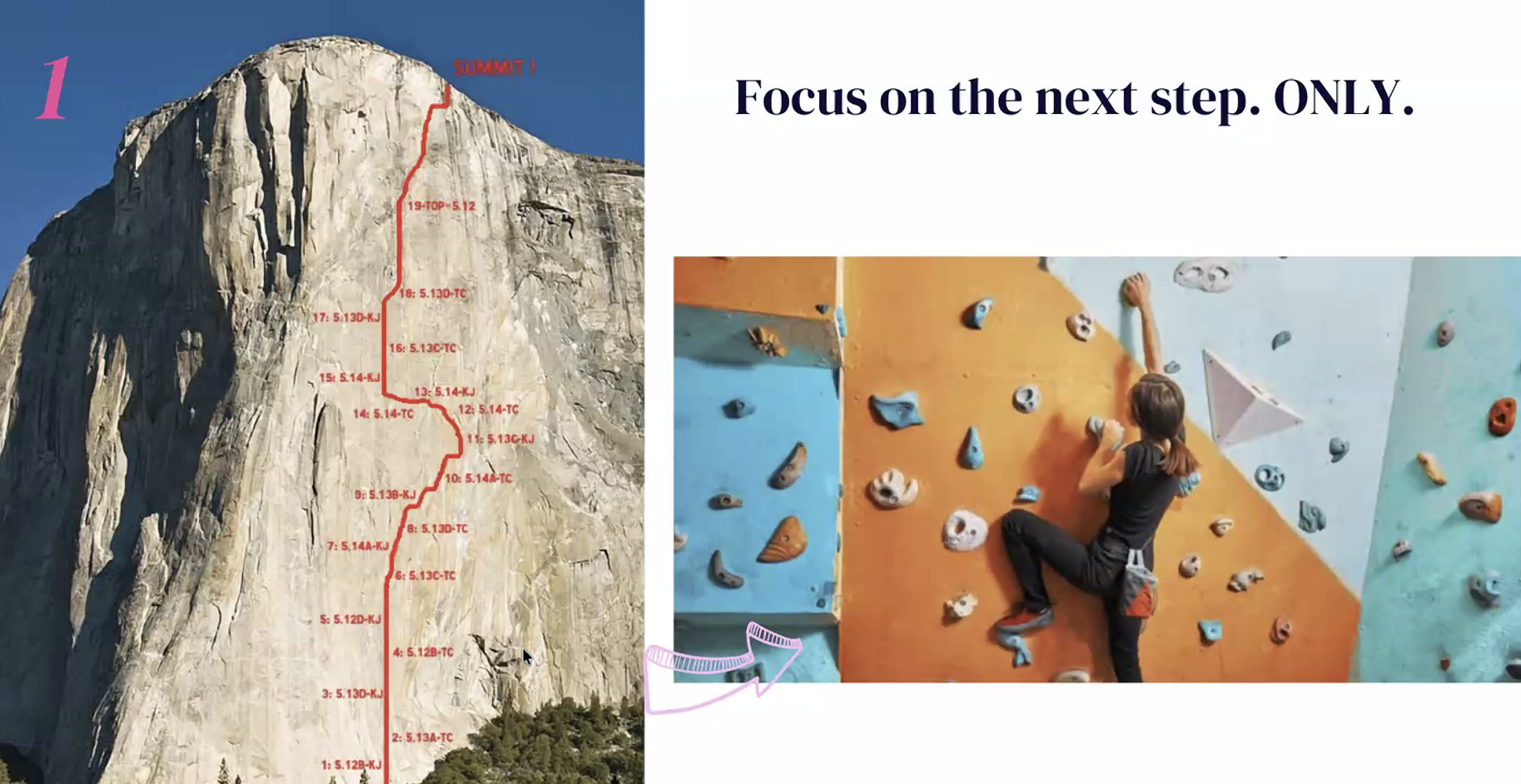
Lottie's first point is the one she comes back to constantly with her own clients. Founders spend their mental energy imagining life at the summit, worrying about translation strategy across seven markets or team structure across five offices, when they're still standing at the base of the mountain trying to get off the ground.
The fix is to define your next pitch, the single next point where you can clip in, breathe, and regroup. For Lottie right now, that's three more retained clients bringing in twenty thousand pounds a month. Everything beyond that is a future problem, and worrying about it now is a distraction dressed up as strategy.
Make sure the pain is actually painful
Lottie's favourite cautionary tale is Blue Elvin, a women's activewear brand built around padded leggings that protected CrossFitters from barbell bruising. The product worked exactly as promised, and the brand had such strong traction in the London CrossFit community that you couldn't go to a Saturday workout without seeing their rail of clothes at the front of the box. It still went under, because it turned out women were oddly proud of those bruises.
The lesson is to get brutally honest about whether the problem you're solving is actually painful for the customer, not just mildly annoying or nice to have. It takes real courage as a founder to admit that what you're solving for might only affect a handful of people, or might not be painful enough for anyone to take action on. The more it genuinely hurts, the more compelling your solution becomes.
Do the thing you're disproportionately good at
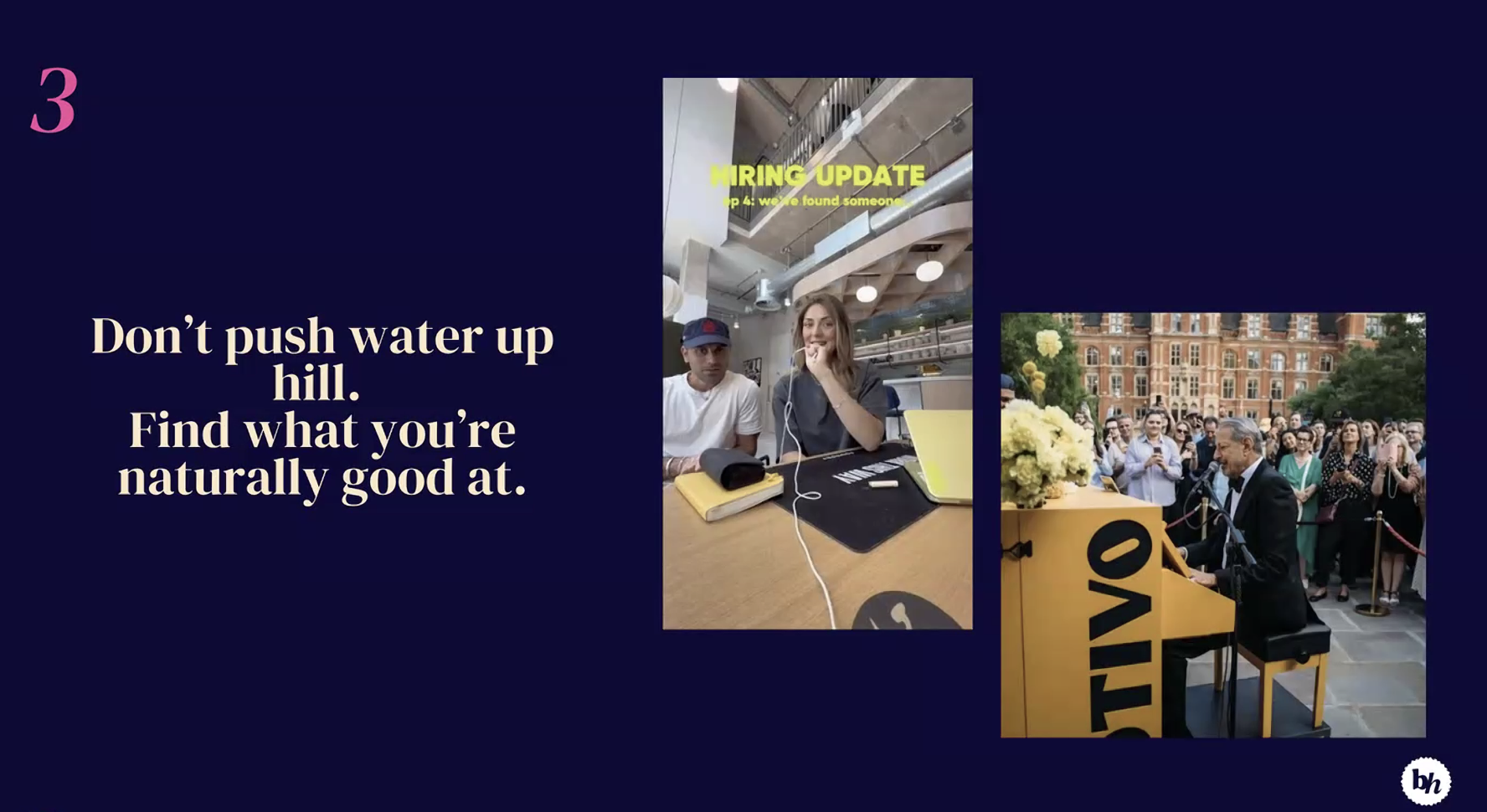
So much of founder marketing gets built from a list of things you feel you should be doing, another Instagram post, another newsletter, a blog nobody asked for. Lottie points to Salt, an electrolytes brand that leads entirely through content, and Botivo, an alcohol free aperitif whose founder was a professional mixologist and built the brand almost entirely through parties and events instead. Both work because each founder leaned into what they were naturally best at rather than copying a generic marketing checklist.
If none of that is marketing, her advice is simple. Pay someone else to do it and spend your energy where you're actually strong.
Get resourceful under real constraint
When Tesco called to say healthier sauce brand Dr Wills had eight weeks to significantly increase its rate of sale or be delisted, Lottie was the marketing director who had to work out what to do. The budget was £500, to sell around ten thousand bottles of ketchup.
Rather than treating that as impossible, she ran a campaign called Save Our Sauce, built on the idea that brands never actually ask customers for help. All three founders posted daily on LinkedIn for six weeks about the very real risk of losing the listing. One, a former banker, stood outside his old workplace asking investment bankers to call their wives and get them to buy the sauce. Another, a strong runner, ran a marathon in the shape of a bottle so they could tell the story on Strava. Old stock that was close to its use by date got pledged to a food bank in exchange for sales, which cost nothing extra. The piece of content that ended up working hardest was an unplanned video of a team member's young son, face covered in ketchup, asking people to buy the sauce so his mummy wouldn't lose her job. The campaign worked, the listing was saved, and the business then had a new, more privileged problem: having told the whole industry they were desperate, they had to rebuild their reputation with a completely different, more premium piece of work.
The mistake founders make isn't lacking money. It's failing to get genuinely creative about what they already have, and trying to solve two problems at once instead of committing fully to the one in front of them.
Sell the category, not just the brand
Early in her career, Lottie worked on Proper Corn, a brand that put popcorn into small, single serve bags at a time when popcorn in the UK was seen purely as a cinema snack, and not a healthy one. The actual job wasn't selling popcorn. It was convincing retailers that healthy snacking was a category worth having on shelf at all, something that sounds obvious now but was a genuinely radical pitch at the time.
The same trap catches B2B founders constantly. If you sell an AI meeting assistant, you're not really selling your brand name, you're selling the category of note taking software, and your competitors are the other tools solving that same job. Founders get so wrapped up in their own brand identity that they forget to tell anyone what category they're actually playing in.
Read your funnel from the bottom up
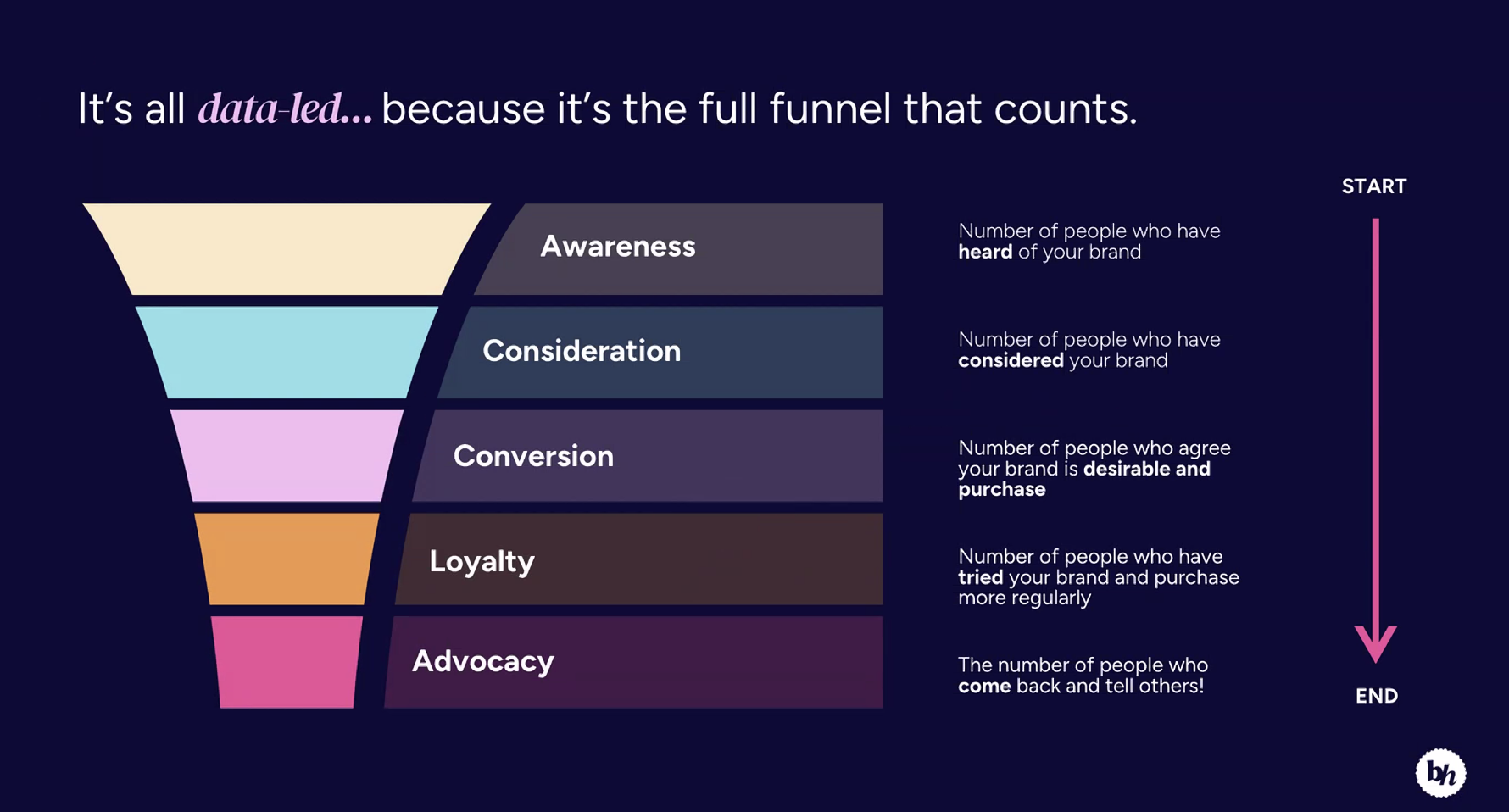
There is no better data in the world than your actual sales numbers, and Lottie is blunt about how often founders ignore them. She's currently mid-way through a packaging redesign project with a founder who has briefed her to fix his packaging, then rejects every single change she proposes, while refusing to acknowledge that his sales data is telling him a wholesale change is necessary.
Her fix is to always read the marketing funnel from the bottom up, not the top down. Start with advocacy: are your existing customers actually talking about you? If not, the product itself isn't good enough yet, and that's the first thing to fix. Then loyalty: are people coming back, or is there a mismatch between what they expected and what they got? Then conversion: are people who want the product actually completing the purchase? Only after all of that do you look at consideration and awareness. In the packaging founder's case, people who taste the food love it and tell others, but they never get that far because the packaging kills consideration before it starts.
The reason to work bottom up is cost. Spending on awareness when the rest of the funnel is broken is one of the most expensive mistakes a founder can make, because you're paying to bring people into a funnel that leaks everywhere beneath. If someone tells you they don't have a strategy, this is the strategy: only put effort into the lowest part of the funnel that isn't already working well.
Treat distribution as free marketing
Lottie spent years in food and drink, where the maths made this unmissable. If a hundred people walk past your product on shelf every day, across three thousand stores, that's roughly three hundred thousand impressions daily, worth millions of pounds if you tried to buy that reach through advertising instead. Meanwhile a genuinely strong organic social result might land ten thousand impressions a day. There's no contest.
That's why she started thinking about distribution itself as free marketing, including placements that generate no profit at all. Getting popcorn stocked in an art gallery wouldn't make money, but it made the brand feel culturally relevant in a way that paid media never could. The same logic works for anything that turns a customer interaction into an advert for you, a branded tote bag or mug being the most obvious example. Since most founders can't afford to pay for every single customer acquisition, getting some of your reach for free through distribution and product itself isn't optional, it's essential.
Marketing is a hundred different jobs, not one
A performance marketer who thinks in spreadsheets and a brand illustrator who draws characters for your packaging both technically hold a job title of "marketing." Lottie's way of explaining this to founders is to imagine a university campus. If you wanted the performance marketer, you'd look outside the science faculty. If you wanted the illustrator, you'd be at the fine art department. They are not the same person, and no single hire will ever cover both.
Her own fractional agency exists because she watched this go wrong repeatedly, founders hiring one generalist marketer and expecting them to be brilliant at everything from paid media to brand storytelling. The fix isn't to look for a unicorn hire. It's to get specific about which individual jobs actually need doing right now, and hire or contract for those skills directly.
Be the head cheerleader
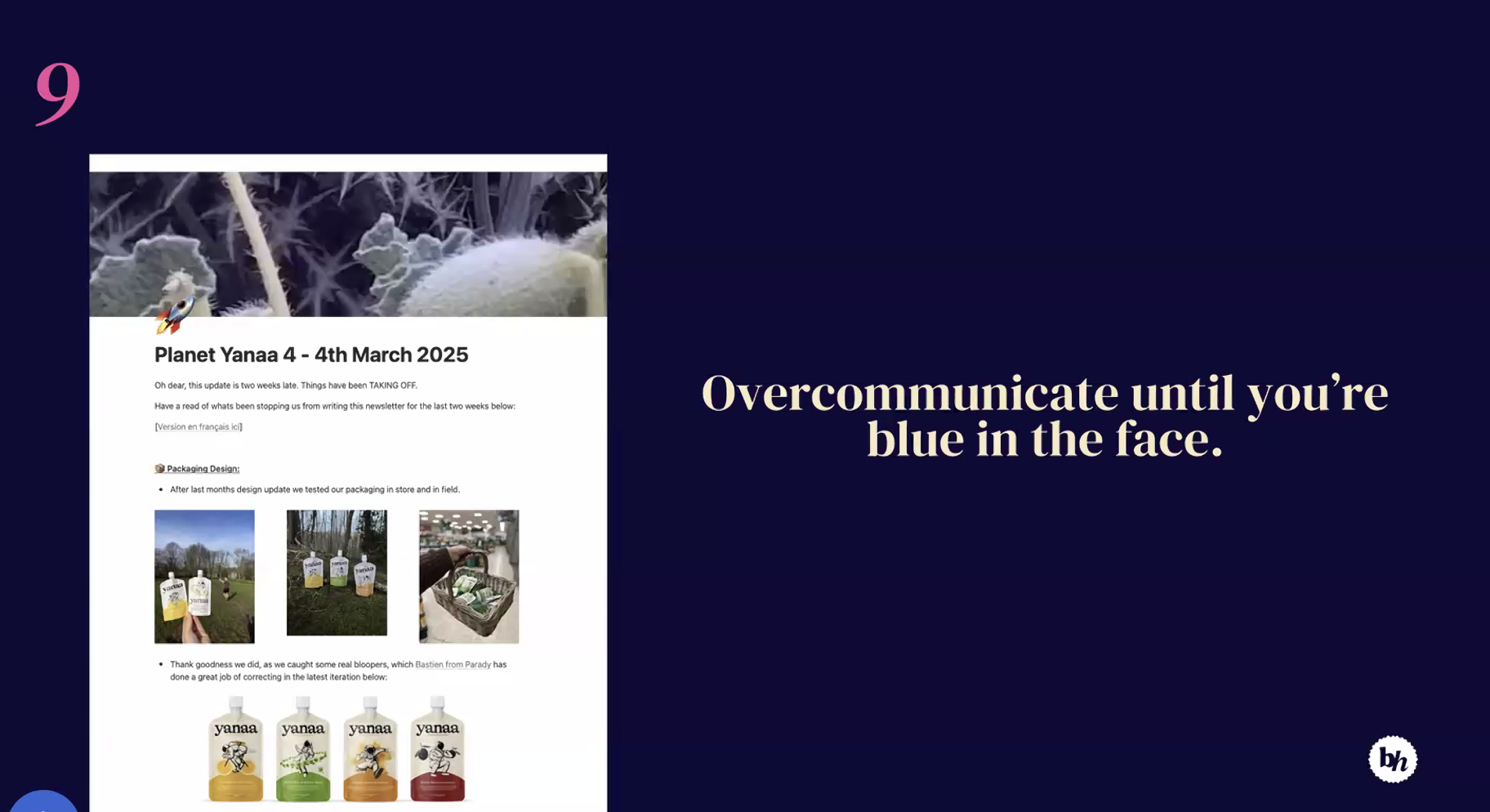
Once you have a team, Lottie's view is that your job as founder shifts entirely. You're no longer doing the marketing, you're motivating the people who are. She shared the example of a founder who sent a weekly newsletter to his own team celebrating wins, customer reviews, and good work. Over communicating until you're blue in the face is, in her words, basically the founder job description.
You don't need every customer on one channel
Asked how to choose between channels when budget and time are both scarce, Lottie pushed back on the instinct to spread thin. Trying to do five things badly produces worse results than committing fully to the one channel or content format you have a genuine right to win at.
She used a real example to make the point: a men's deodorant brand whose core customer was fifty to sixty five years old told her they wanted to go all in on TikTok. Her instinct was that older men simply weren't on the platform, and she said so. The founders were excited about it anyway and pushed forward. A year later, they'd driven a 50% uplift in sales across Amazon and retail, because the sliver of their audience that was on TikTok turned out to be more than enough to shift the business. You don't need all of your customers on a channel. You need enough of them there, paired with content you can genuinely commit to producing well.
On the specific question of whether Instagram requires paid spend to work at all, Lottie agreed it largely does now, since Meta's business model is built around advertising and organic reach suffers for it, unlike TikTok or LinkedIn, which still reward individual creators. Her advice was to question whether Instagram is the right channel at all before defaulting to a budget question, and to only spend on paid ads once you're genuinely confident in your product and unit economics, since a high customer acquisition cost only makes sense against a high lifetime value.
Finding real pain points
Asked how to actually uncover what's painful for customers, Lottie described a technique sometimes called the seven “why’s”, or peeling the onion. She demonstrated it live using Vaida as the example. Asking a leading question like "you're annoyed there's no marketing community in the UK, aren't you" isn't insight, it's just leading the witness. Asking an open question instead, like what would make your working week better, and then repeatedly asking why the answer matters, takes you somewhere real. In her live example, "I'd like to meet more people" became, after a few rounds of why, a much sharper fear about professional reputation and financial insecurity if the work itself wasn't good enough. That underlying fear is the actual insight worth marketing against, not the polite surface answer someone gives you first.
The other rule she was firm on is capturing the customer's own words, not your tidied up version of them. The moment you paraphrase someone's pain point into cleverer language, it stops being something they recognise as their own experience.
On where to actually do this work, her answer was simple and slightly deflating: there's no single method, you just have to get close to the customer in whatever environment they naturally exist in. For food brands, that means standing in the supermarket aisle. For B2B, it means trade shows. For a restaurant, it means walking the tables yourself. Founders often already sense the answer because they're doing the early sales themselves. The mistake is not bothering to do the work properly, not the lack of a perfect methodology.
Co-founder or not
On whether to bring in a co-founder, Lottie's answer had nothing to do with skills gaps or filling in what you're not good at. It comes down to being genuinely honest with yourself about what you actually want from the business. If you're optimising for the maximum possible exit value, there's a real argument for a co-founder. If you're optimising for the maximum personal financial outcome for yourself specifically, that argument mostly disappears.
She used her own choices as the example. She's not building toward a big unicorn exit, and she's completely at peace with that, because what she's optimising for is enjoying the journey, making her own decisions, and being able to take a full year off on full pay to look after her baby, something she couldn't have done with a co-founder to answer to. The wider point is that so many founders come to her with a marketing brief when the thing that's actually unclear is much bigger: do they want to build something to sell, or something for sustainable income, and what does good actually look like for them personally. Once that's genuinely clear, decisions like whether to take investment or bring in a co-founder tend to answer themselves.
Want more practical sessions like this?
Subscribe to the Businettes newsletter and get access to workshops that actually teach you how to build and scale your business.
About Lottie Unwin
Lottie Unwin runs Brand Hackers, a fractional marketing agency for startups, Upworld, a marketing community, and Uptalent, a recruitment agency for startup marketing.