
How to Unlock Retail Partners and Expand Internationally
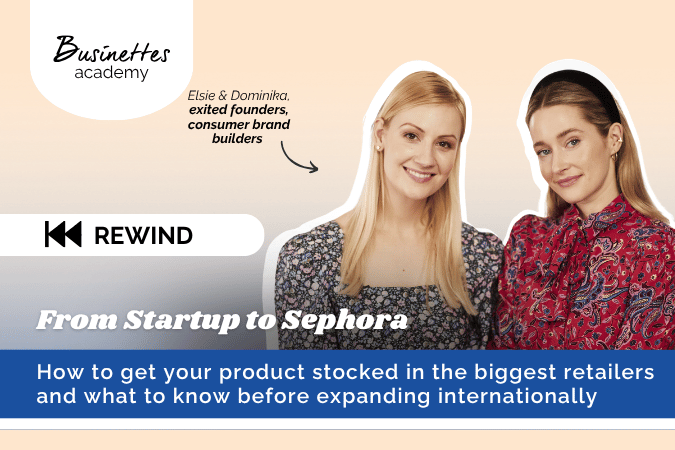
A Businettes Academy recap with Elsie Rutterford, Co-Founder of BYBI Beauty and Rayro
Getting into a retailer is the easy part. Staying there is the hard job.
That's the lesson Elsie, co-founder of Bybi Beauty, learned while scaling a sustainable skincare brand into 3,000+ retail doors worldwide, including Boots, Target and Sephora, raising £10 million before exiting in 2024. She's now building Rayro, a kids' bath and body brand, and running DE London Consulting, advising early-stage consumer brands on getting to their first million.
Here's what she shared with the Businettes community.
🚪 The Hard Job Isn't Opening the Door
Bybi launched into ASOS in 2017, hand-packing the first orders in their own studio. Over the next three years they went into Oliver Bonas, Anthropology, Harvey Nichols, Selfridges, then Sephora Europe (the youngest brand ever to launch there at the time), Sephora APAC, and Boots UK.
"Not many of them stuck. The hard job isn't opening the door, it's staying there. A lot of brands underestimate how difficult sell through is once you're actually on the shelves."
Retailers have shelf productivity targets. If you're not selling, you're out.
📦 What a Big Retail Launch Actually Costs
In 2021, mid pandemic, Bybee launched into Target across all 1,800 US doors. It transformed the business, but the commitment was significant, including roughly $100,000 just to produce a single marketing display unit for every store.
"1,800 doors for a 3 year old brand into a market where we weren't present was actually completely bonkers. But we couldn't not take the opportunity."
Her honest reflection: it might have been smarter to phase the rollout, starting with the top 10-20% of doors, since that tier typically drives most of the revenue anyway. Lower investment, lower risk, same learning.
📣 How They Actually Landed Retail Partners
Two things mattered most. Consistent PR from day one, which put them in front of the buyers actively scouting new brands. And warm introductions over cold outreach.
"We were trying to get in front of Sephora US and they were ignoring us. Then we dropped in the name of our investment director at Unilever Ventures, and she replied within 10 minutes."
Buyer inboxes get spammed constantly. A genuine point of connection, even a small one, changes everything.
💰 Know Your Margins Before You Launch
Beauty retailers typically take 50-70% margin off RRP. Distributors can take up to 80%. Price for retail from day one, not retroactively.
"A really healthy gross profit margin for beauty would be around 60-65%. If you go back and do the maths and your unit economics can't support what they're asking, that's a real problem."
If margin won't move, other levers exist: payment terms (30 days is far better than Boots' standard 60), marketing contribution through a joint business plan, and exclusivity, which can be traded for better terms but needs careful limits on length and scope. Watch out for listing fees.
"We've never paid a listing fee. Whenever I hear it, I push back."
🗂️ Come Prepared to Qualify Them Too
Bring proof of traction, whether that's early sales data, reviews, social following, or a strong founder profile. But also use the meeting to ask your own questions: do they launch full chain or phased? What marketing support is included? What's the buy-in window?
"It's an opportunity for both of you. You're not the only one selling here, they should be selling to you too."
🌍 Nail Your Home Market First
Bybi expanded internationally early and discovered an unexpected strength in Scandinavia, which became a top market. But looking back, Elsie wishes they'd spent more time proving the model at home first.
"I really challenge you to say, have I done what I think I can with my home market before I start looking somewhere else?"
Before entering a new market, understand the true cost: compliance, tariffs, logistics, and whether you need local, on the ground support. It's easy to get excited about an order that ends up costing more to fulfil than it earns.
💳 Funding Retail Without Investors
For founders bridging cash flow without raising, invoice financing is worth exploring. Lenders front up to 85% of a confirmed retailer PO once stock has shipped, then collect the balance once the retailer pays.
"They own the debt and chase the payment for you. Highly useful, but you'll typically need a couple of years of accounts and some profitability to qualify."
⚖️ Making D2C and Retail Work Together
At Bybi, D2C stayed around 20% of revenue. The channels can complement each other, but if they compete too directly, retailers start discounting to win the sale, which cannibalises your own site.
"Give D2C something retail can't. Loyalty schemes, bundles, launch exclusives. That way each channel does its own job."
What's Different at Rayro
Building a second consumer brand, Elsie is doing things differently. Slower, more targeted retail entry instead of chasing every door at once. Learning who the customer actually is through D2C and TikTok Shop before assuming where they shop. And leaning into real world moments like pop-ups and offline events to test and learn directly.
"The barrier to entry to launch a brand is practically non-existent now. Be really clear on why your brand deserves a place on the shelf, because you're not building something that already exists."
Want more practical sessions like this?
Subscribe to the Businettes newsletter and get access to workshops that actually teach you how to build and scale your business.
About Elsie Rutterford
Elsie is co-founder of Bybi Beauty, a sustainable skincare brand she built with Dominika Minarovic into a global business stocked in over 3,000 retail doors, including Boots, Target and Sephora, raising over £10 million before exiting in 2024. She's now building Rayro, a kids' bath and body brand, and runs DE London Consulting, supporting early-stage consumer brands with retail strategy, distribution and growth.