
The Financial Blind Spots Most Female Founders Don't Know They Have (UK Founder Edition)

A Businettes Academy recap with Lucy Wayment of Welleness.ai and Lizzie Goswamy, Financial Adviser
How many times have you told yourself you'll sort your own finances out once the business is stable?
In our recent Businettes Academy session, Lucy Wayment, co-founder of Welleness.ai, and Lizzie Goswamy, an independent financial adviser with over 15 years in financial services, walked through five financial blind spots founders keep putting off. Here's what they shared.
Blindspot 01: The Pension Gap for Founders

Women across the EU retire with pensions 25% lower than men's (Eurostat, 2024). For founders, the gap tends to be worse.
"We very often pay ourselves last, so the business gets reinvested but your pension pot sits untouched. There's no one nudging you the way auto-enrolment nudges your employees."
Career breaks, part-time years and unpaid care work all take contributions out of the pot too. If you've lost track of old pensions, the UK's Pension Tracing Service can find every one you've got. From there, decide roughly when you want to retire and your appetite for risk.
One easy next step: check when you last actually paid into your own pension.
Blindspot 02: Salary vs Dividends
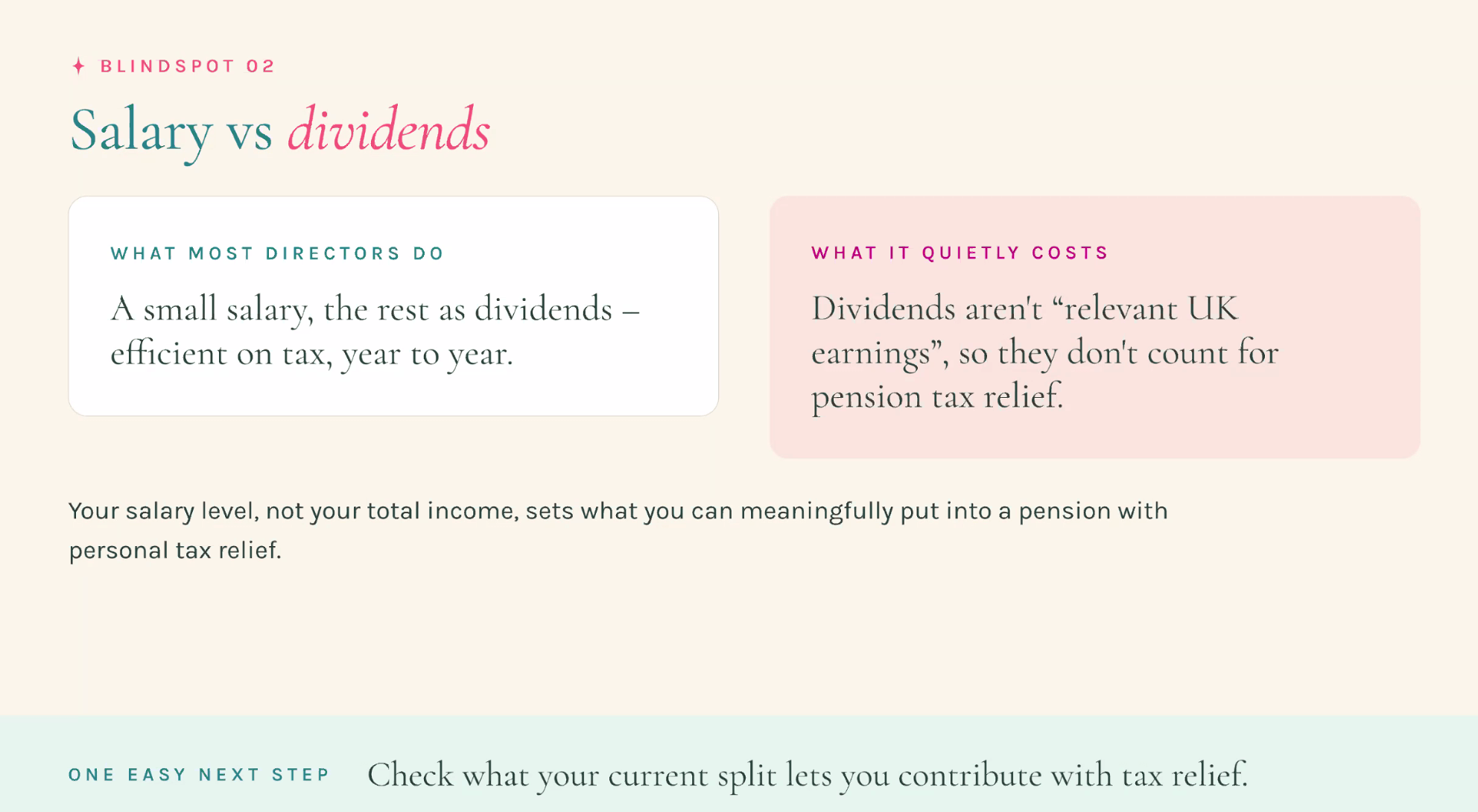
The classic UK director move, a small salary topped up with dividends, is efficient on tax. What it quietly costs you: dividends aren't "relevant UK earnings," so they don't count for pension tax relief.
Take a £50,000 salary and you can put up to £50,000 into your pension with tax relief. Take £10,000 as salary and £40,000 as dividends instead, and you only get relief on that £10,000.
Sole traders have it simpler: your allowance is the lower of your full year's accounts or £60,000. And if you're setting up a limited company with anyone else, get a partnership agreement in place, or by UK default, the Partnership Act of 1890 applies, making every partner jointly and severally liable.
One easy next step: check what your current salary and dividend split actually lets you contribute with tax relief.
Blindspot 03: Mortgages When You're Self-Employed

Lucy shared this one from personal experience.
"I wasn't able to access the whole of the market because I didn't have the accounts I needed. I stuck with my existing lender, and it wasn't the best rate, but it was okay."
Most lenders want two to three years of accounts or SA302 tax documents before they'll even look at you. Some assess salary only, ignoring dividends and retained profit entirely, so your real income can disappear on paper. A smaller pool of lenders will work with one year of accounts, and specialist brokers can reach lenders who read your whole financial picture instead.
"Ideally you'd start thinking about this a year in advance. The answer isn't always going to be yes, which is heartbreaking, especially when you're an adviser who really cares."
One easy next step: if a mortgage is on the horizon, talk to a specialist broker ahead of time.
Blindspot 04: Income Protection

No sick pay. No employer safety net. If you couldn't work tomorrow, how long could you and the business actually cope?
For Lizzie, this isn't theoretical.
"The reason I ended my career break after having my children is because a friend of mine got breast cancer. I called her and asked if she had any protection in place. That's what pushed me back into advising. One in two of us will get cancer in our lifetime. You can't do anything about the pain, but you can make it financially easier."
To make it concrete: a 45-year-old wanting £85,500 of annual cover, with a three-month deferred period, might pay around £88 a month, with insurers typically paying 60-75% of income. If you employ anyone, work out what months of their absence would cost the business. And if you're in business with someone, without protection, their share could pass to the wrong person.
One easy next step: check what cover you currently have, both personal and business.
Blindspot 05: Equity vs Cash
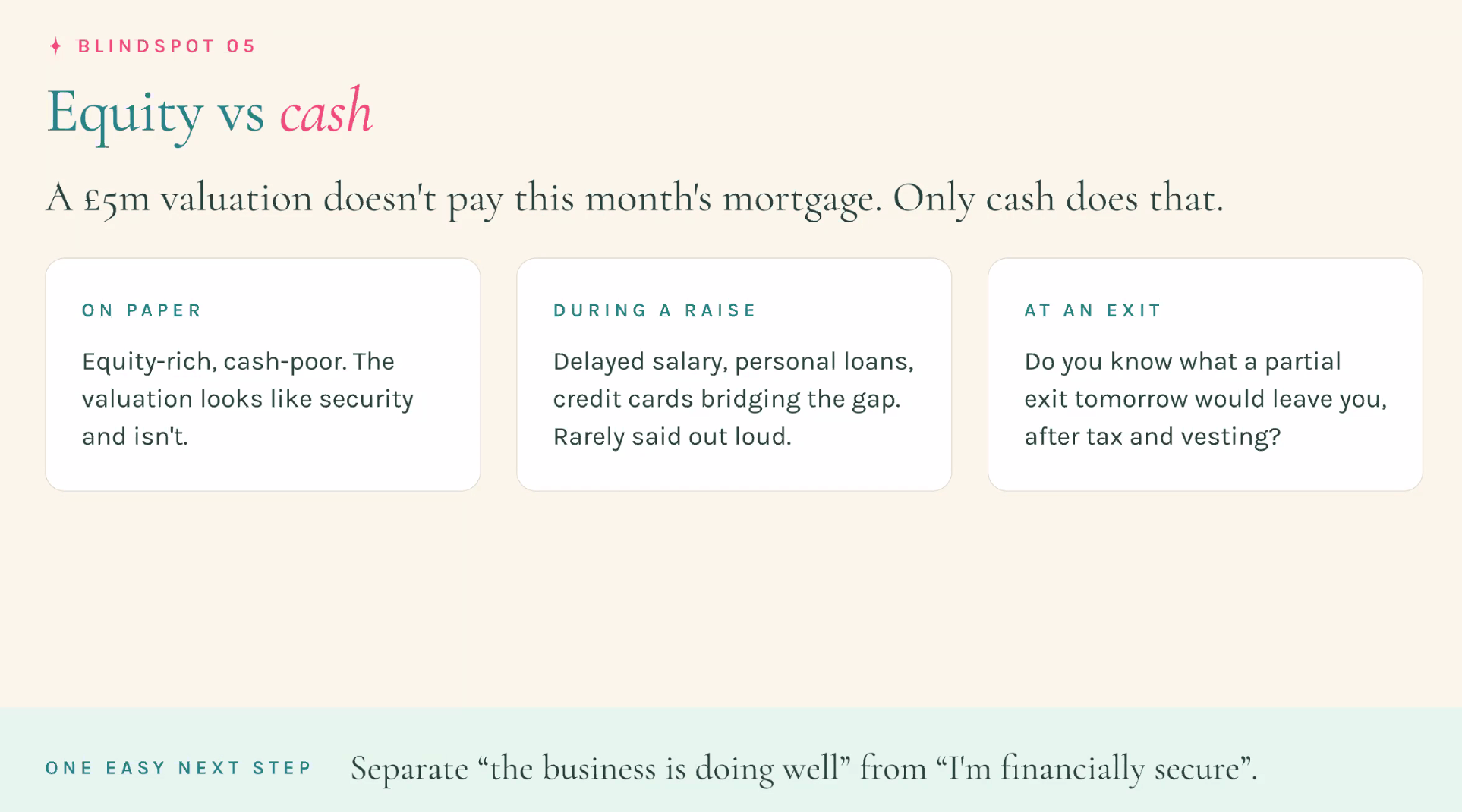
A £5 million valuation doesn't pay this month's mortgage. Only cash does that.
"It's very common for founders to be equity rich and cash poor. You've got a cap table you're proud of, a valuation you're pleased with, but that doesn't pay your pension contribution."
During a raise, that often means delayed salary, personal loans, or credit cards quietly bridging the gap, rarely said out loud. At an exit, know what a partial exit tomorrow would actually leave you after tax and vesting, since the number on paper and the number that lands in your account are often very different.
"You cannot run a good business if you are incredibly stressed about money. It takes up so much of your brain capacity."
One easy next step: separate "the business is doing well" from "I'm financially secure."
Quick Answers From the Q&A
Maternity pay as a director: for the first six weeks you can pay 90% of earnings, then the lower of roughly £194 a week or 90% for the next 33 weeks. Dividends don't count, only salary. Sole traders can claim a flat weekly rate for 39 weeks if they've paid National Insurance for at least 26 of the last 66 weeks.
Sole trader tip: keep two bank accounts, one you spend from, one purely for tax.
When to see an adviser: "the best time was five years ago. The next best time is today." Mortgage and protection advice is typically free, paid by commission from the insurer, not by you.
Working across borders: seek advice in the country where you're tax resident, not where you earn.
Want more practical sessions like this?
Subscribe to the Businettes newsletter and get access to workshops that actually teach you how to build and scale your business. No fluff. Just real insights from people doing the work.
About Lucy Wayment and Lizzie Goswamy
Lucy Wayment is co-founder of Welleness.ai, a UK financial advice platform for women, built after her own redundancy on maternity leave led her into self-employment. Lizzie Goswamy is an independent financial adviser with over 15 years in financial services, specialising in protection and helping women navigate their finances.